
Joe Cheetham (b. Macclesfield, England) is a painter based between Glasgow, Scotland and Milan, Italy. His practice deals greatly in the study of the face, longing, and moments of pause or waiting. This year, Cheetham became represented by The Tagli, a contemporary gallery based in London, and will be showing with them at Untitled Art in Miami this December.
Stylistically your work has changed quite drastically over the years. I remember seeing your old work for the first time, specifically your degree show, and being really shocked at how different it looked to the work that you’re making now. Can you talk me through that change?
I did my MFA in Edinburgh from 2015 to 2017. I was making quick oil paintings from source photography. It was all about the juxtaposition of things. When you do an MFA, when you do any degree, it’s not about coming out as a finished artist or who’s going to see my degree show, or what opportunities are going to come for me, it’s much more about changing. You should go in as one artist and come out as another. That’s crucial. People think it’s like finishing school for studio practice.
The first thing I did was change medium and I got rid of all my paintbrushes and all my paints. When you’re making oil painting with brushes, you’re quite close to the surface and you’re very involved with the surface. A level of control is forefront. It was about reversing that process and taking my hand as far away as possible. I was painting with fabric dye and making marks on wet canvas. Kind of like a lack of control or relinquishing control giving control to the medium. Then I started making spray paintings through the back of the canvas. All the cartoon paintings that you see of mine from up until the last three years, they’ve all been oil paintings through the back of the canvas.
It’s a very open weave and then it’s forced through. The things that you would do last, you do first. You’re pushing it through and it bleeds and you have a certain amount of control, but not very much. I was trying to find a place where I felt comfortable making a painting. Well, comfortable is probably the wrong word, but a different space to make paintings from. The paintings that I then made came out of this technical exploration or this material exploration. That was that one major switch.
When you’re making paintings that are fast with dye or spray paint it’s quite performative. You’re adopting an attitude in the same way that a performer would do if they were on stage. I guess the attitude I was adopting felt quite brash. Materials like spray paint have certain connotations. It’s quite tongue-in-cheek. The work didn’t take itself too seriously. It was about abstracting that form, that cartoon, through layering and layering and layering.
I left the MFA with an ability to make paintings with a strong visual language. That was new and it felt like I had a certain level of freedom. The research that I was doing at the time was in rave culture and ideas about communal joy, about hedonism. At that point in my life, early to mid-twenties… it’s quite a hedonistic period for a lot of people. I wasn’t making paintings about what I was up to, it wasn’t that grandiose, but that was what I was interested in; the music, the energy, it felt like the paints, or the studio was moving at a pace again. Prior to that, it would have been very slow and that’s where I’m back to which is interesting.
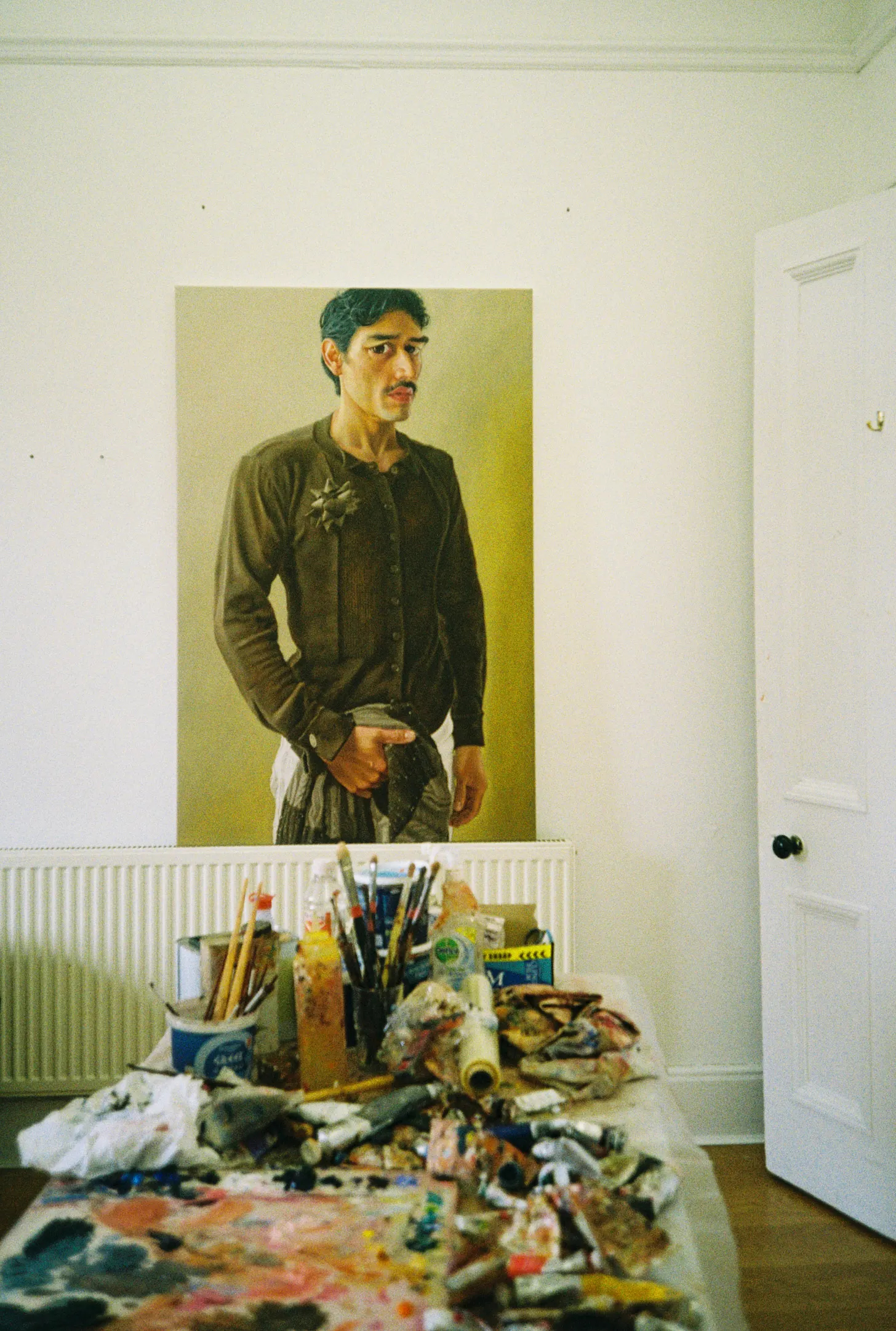
There’s so much movement in those paintings from the MFA and the paintings that you’re doing right now are so still. The added context bridges that gap…
It’s a massive change.
They’re so different.
For me, though, the process is still the same. I’m looking at an archive and I’m doing a lot of drawing. If you look at the paintings, unfortunately some of them are taken off Instagram or websites because the problem is when you make this big change, you make a lot of crap in between, but that crap is the kind of stuff that shows the change.
I had this one day where I got a sketchbook and I was like, Okay, this is what drawing the face looks like. Now, by the end of the sketch we’re going to use something different. So there’s a drawing on the wall. Which is one of the final styles where I felt like I found something new. They’re still cartoons. I’m working from photos but the cartoon drawings are then put into photoshop and then cartoon-ed more. It’s a constant returning to a style.
With the old cartoons, it was people who were excited to go out. There’s big smiles, big eyes. Now, these are still cartoons, but the emotions are much more subtle. I’m trying to get a different feeling. All of the features are proportionally massive compared to what they should be on the face, particularly the eyes. And you have these strong brows. I’m trying to create a certain feeling, but it’s much more subtle. For me, whilst they look visually very different, it’s part of the same practice.
What draws you to portraiture specifically in your practice right now?
What draws me to portraiture? Figurative painting has always been something that I’ve enjoyed. I think if you look at the books that are down there, I’m not particularly a massive collector of art books, but a lot of those reference books are figurative painting. I think it allows me to explore emotions which are quite close to my own.
The way I’m painting at the moment, it’s gone from fast paintings which are about getting a certain energy out, to now being much more about things which are more meditative. I spend as much time as possible with the surface, so maybe there’s something to do with painting a person. Even an imagined person, a composite of various photos, or Aitor González, or working for models that I know. Whilst I’m following a likeness or following a photograph, it’s very much an exchange between me and that person with that face that I’m painting. If it goes a certain way then I just allow that to happen.
A lot of the work is about balance in every way. Portraiture is just a vehicle for me to find that. There’s an obvious connotation with classical portraiture and history painting and everything else. You have to be aware of the weight of that. And as soon as you put oil paint on a piece of canvas then you’re engaging with that. But it comes back to a style and attitude thing. This is just a mode I’m working in at the moment. I certainly don’t think this would be where I am in five years. I’ll be doing something quite different again. At the moment, portraiture just feels like this kind of stillness, the weight of painting that I feel like I can make, and the presence that it has in a space. All of that marries up with the kind of feeling of work I’m trying to make.
That’s a really difficult question to answer. I’m not making paintings that are interrogating the medium or the history of portraiture or anything. I want them to feel quite contemporary.
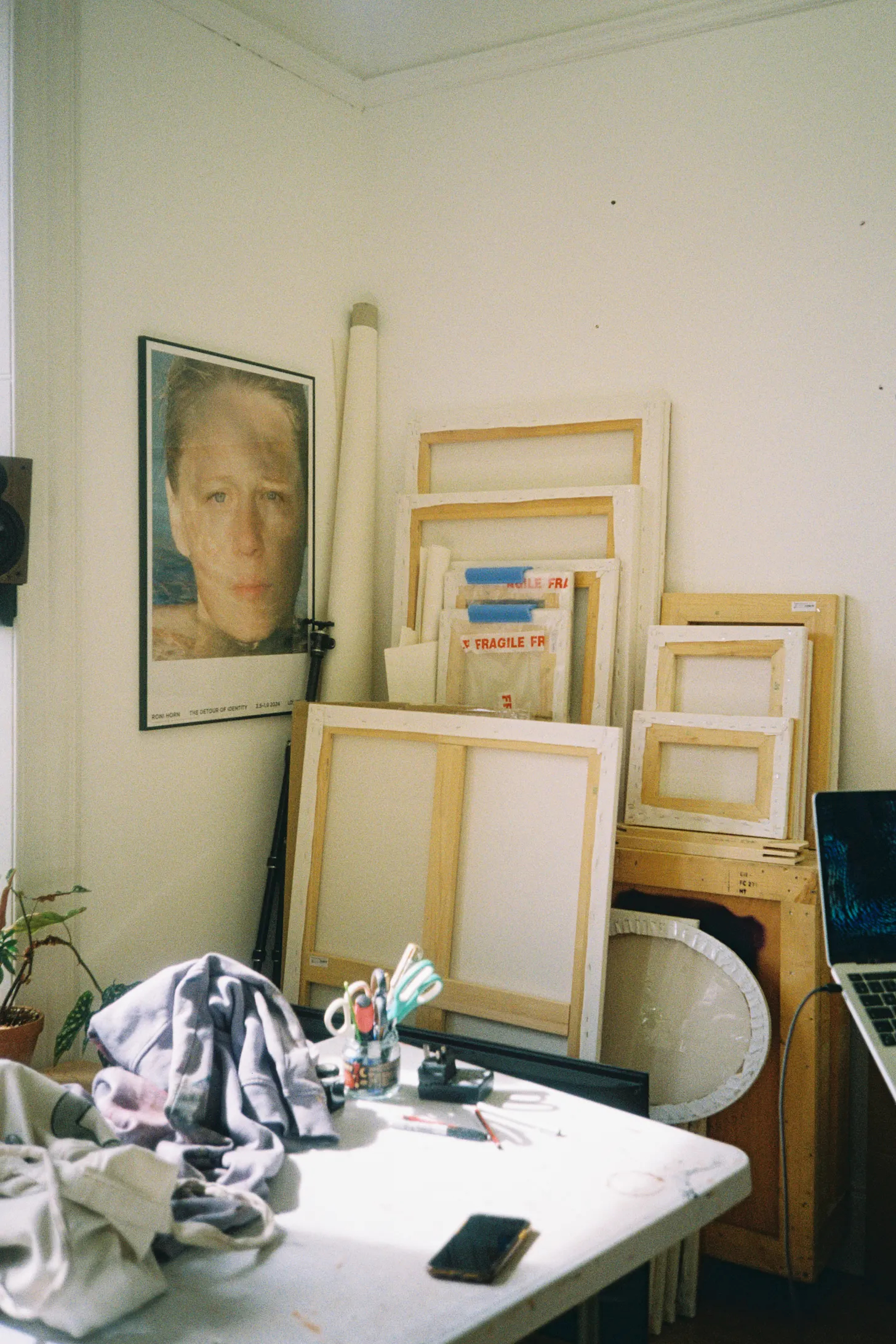
There’s two touchpoints that I want to ask you about. I don’t know you super well. We’ve not spent a lot of time together, but even just coming in here, you’re getting ready to move, you have a lot of stuff to finish and you’re talking to me about these paintings in a very “painterly” way. Like “this is the under painting”, “this is grayscale”. I never did painting. I always found it really quite difficult. And the first 20-30 minutes before we started recording… you are a very capital “P” painter.
I would say so, yeah. I think that’s something that I need to be really conscious of and I think you’re right. You’ve caught me at a certain moment. My partner was here. She was laughing because these paintings over the last few weeks have kind of taken over our lives and perhaps my head should be in other places, like moving country. I’m definitely making paintings in a traditional way at the moment.
You seem to know and understand the medium very, very well. When you get into the fine arts, painting more specifically… it’s such a heavy medium to work in.
Oh yeah, of course. Heavy, incredibly like… male dominated and, I mean, the paintings, they’re all men.
That was the second touchpoint…
To answer that question, I think my answer would be that, up until a recent time, what I would do is start with a drawing. And that would be often completely imagined. When I first began it was of my own likeness…
I could tell…
I was using myself as a reference a lot and then I was like, okay, if I’m going to make a painting that has a certain level of realism, I need to use reference points. So then you start combining drawings. I would have a pencil drawing with Photoshopped hair on top of it. I’m using clothing references from big brands.
For me, I was making these gender non-specific figures at first. They were a bit softer and there were some more femme characters, more masc characters. Over time, it’s been more of a commitment to form itself. I would say it comes back to this idea of... so much of myself was in it that I feel, especially if I’m trying to portray these quite subtle emotions, it’s easier when I’m closer to them. If they are male. It’s interesting because I think as soon as you start to make your own visual language and all the figures kind of all need to look from the same visual identity. If you were doing a cartoon or an animation, it needs to be stylistically quite strong. As I’ve arrived at the figures that look a certain way, I realized that I have people that I know that look like that. So Aitor, for example, is someone that I’ve always known. We were talking about our friend Louis before as well. I’m very aware that there are connotations around that decision but I think it’s so that I feel like I have a much closer relationship with what I’m trying to portray.
I remember on Friday during this discussion that John Douglas Miller had with France-Lise McGurn… in the question portion, somebody from the audience had asked, “do you ever depict men or male bodies?”. France-Lise’s work draws a lot from her own body. She was saying that she’s not really thinking about it in terms of a female form or a male form. She’s just drawing from her own subject matter. Sometimes there are more androgynous bodies or male bodies, but nobody cares when they’re there.
When it comes to things like “this artist is only depicting this gender/race/etc.”, I think it’s something that’s always good to reflect on or consider, but I don’t know how valuable it is to change your entire practice around that thing. I don’t really know how helpful or authentic that is. At one point, less so now, but I’m thinking maybe like five, six years ago, there was a big push for that kind of reflection and then change to be made. But that stuff doesn’t really stick. And so it’s just... I don’t know. I’ve looked at your work and I’ve noticed that it’s male dominant and also majority white, but I also know that you’re a white man. And so I’m not really expecting you to have this expansive, diverse collection of imagined people. And, with that, I know that that doesn’t equate to you not seeing those people in real life.
Yeah, there is that domination in terms of me painting majority white people. I think to go back to what you said initially, if you become conscious of like, oh, my painting needs to become more diverse, it becomes tokenistic. So much of what I’m painting in terms of making a decision to make a painting increasingly now that I’m using more photographs, it’s the malleability of a face. Some people, irrespective of race or gender, have more painterly things about them. I have an archive and I’m literally working through a list. It’s like a waiting list of paintings that need to be done so I’m just moving through it.
If I’m putting my work out you have to be able to stand up in front of your work and say yes, this is what it is. I’m aware of who I am as a person as well as the space that I occupy in the art world. There’s a lot of me and I’m making more paintings of people that are similar to me. I think you just have to stay authentic and be conscious of those things. Someone can not look like me at all. Someone can be very different to who I am, but when I’m painting someone, I can have a connection to a certain feeling that the drawing that I’ve made of them feels like. It’s led by that.
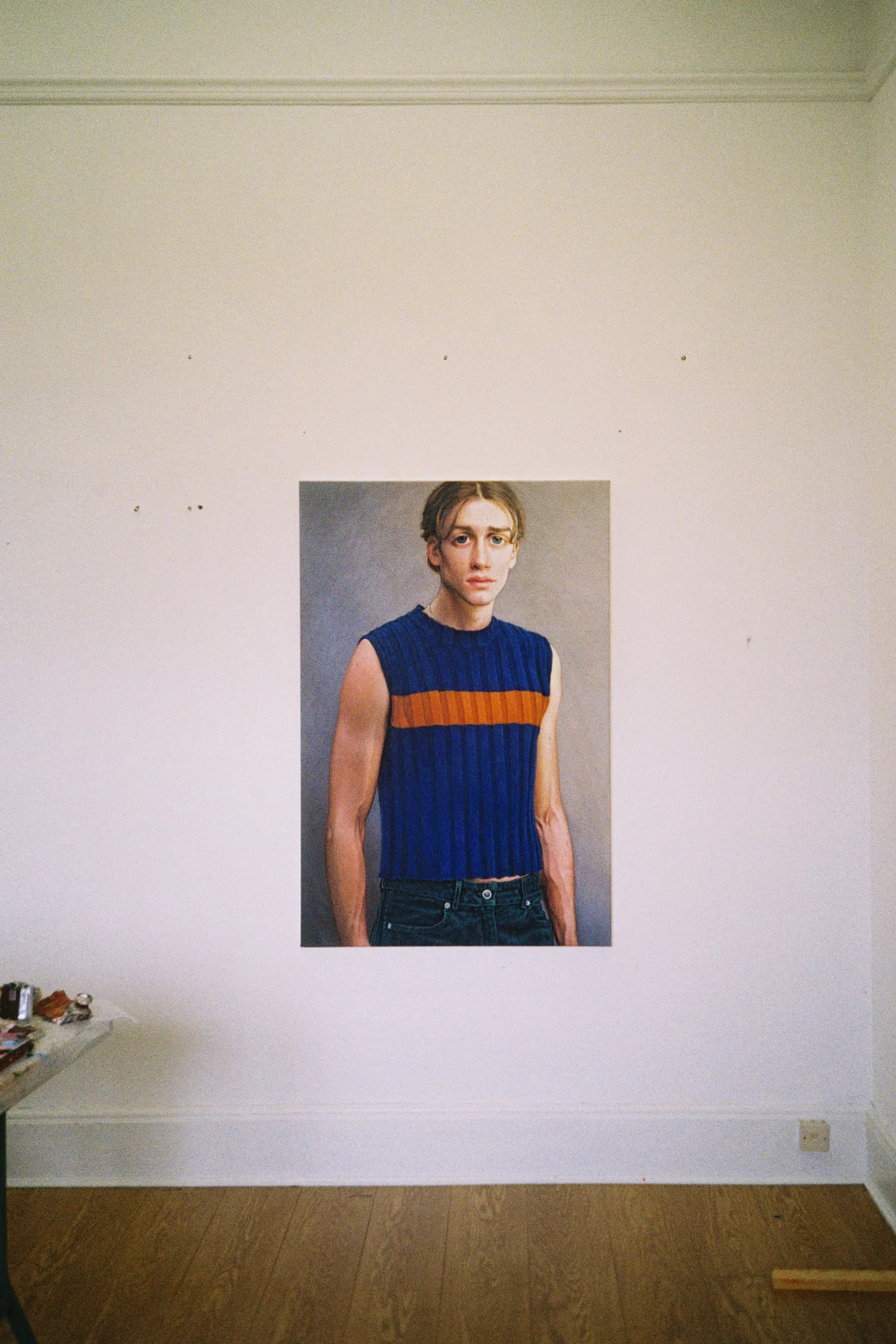
The portraits usually feel very brooding and melancholic. Can you talk to me about your colour palette and how that translates to the way you want the viewer to feel when looking at the portraits?
I’m trying to make paintings that are portraits, but also, they’re about a moment of pausing. Making a painting, you’re pouring everything into the frame. So in the same way that I’m pouring a lot of features into the face and they need to find their own stillness where they’re balanced, it’s the same when you’re composing a painting. You’re pouring a lot of things in and balancing them. If they were to become too static, the painting is dead. I’m trying to make paintings of people that are almost paused in states. They look not at you, but through you. In terms of making decisions, I’m always cropping the top of the head. If I show you the top of the head, I always feel like paintings are falling out of the canvas. As soon as you crop something, especially working with photography, it has a filmic connotation in that it’s not a complete shot. It’s a moment. A lot of the feeling is trying to heighten that.
I wouldn’t say they’re sad. Maybe they have this kind of longing. It’s quite ambiguous, it’s quite open, but there is a certain moment of stillness. I would say it’s a pause; a pausing. Obviously we’ve spoken at length about the cartooning and bigger eyes and that gives you a feeling of sadness or openness or longing or whatever else. However, I think it’s much more open-hearted than that. I think sadness and the idea of longing is so complex and everyone would describe something too strong. It may be something more like waiting. I don’t know. Their gaze invites a relationship with them.
In terms of the colour, I’m making very conscious decisions about the clothing. That’s the first thing that impacts the colour. I look at a lot of particular designers and a lot of it is sourced from their websites, their social media, wherever you get images from. I was making a lot of paintings of people in scarves. They gave off this feeling of swaddling. It has a certain connotation to me of something being slightly held and there’s a fragility to it.
I think about the portraits in thirds. It’s a lot of painting to fill if there’s no point of interest in between. By splitting it, it provides a strong, compositional thing. The smaller paintings are 45 x 35 centimeters exclusively, and I’ve just changed to 50 just to give me a bit more space. If you look at the 45 x 35 ones, they’re thirded as well. The eyes are always a third of the way down, the neck or the shoulders are always two thirds of the way down. Compositionally, they’re static, so in a lot of ways I’m putting all these like rules and parameters around that. The way my brain works is that I have like a set thing. If I’m making oil paintings, I’m going to make a size that looks like this and that gives me so much freedom. I would be completely lost without those anchoring points. When I was making spray paintings, a lot of the paintings were 160 x 130 because it’s a decision made for you.
For this portrait of Aitor, you’ve got a pink shirt. The green background is quite… what would you say? It’s a complementary colour.
It reminds me of school portraits or a Macy’s or JCPenny photoshoot.
I’ve spoken about the reference of when you had your school pictures; the backdrops, the way they were painted. Absolutely. And again, if we’re talking about contemporary designer clothing, the images are quite editorial in the way they’re shot. It’s probably a cyclical reference in terms of these colour blocks that look great in paintings. They look great in photography. They look great in clothing. I said to you before we started recording, I spend weeks and weeks and weeks just on the face. If you came in two weeks ago, this would have looked like a completely different painting. Really quite drastically they would change. The shape of the head would change, the nose would move. It’s all about finding this point of balance.
There’s this woman who I follow on TikTok who’s really obsessed with using this big eye filter. There’s this book that was adapted into a movie called The Uglies. Somebody had commented on one of her videos using that filter saying this is what they imagine the “pretties” looking like in that book. They were described as having this ethereal beauty and appearance with really exaggerated features. Like when you think of doe eyes or people’s obsession with almond shaped eyes…
They’re very much like that. I look at early Lucian Freud paintings. That’s quite an obvious reference point. I could make the same volume, maybe twice as big, but I have to return to a certain level of realism so that you have this relationship with them.
If Aitor was to stand next to this painting, you would know that it was him. It creates a slight uneasiness, I guess. You’re aware that you’re looking at someone and you’re having a human to human interaction with it, but there is something about the features being enlarged and unbalanced that invites a certain type of intensity. So yeah, the doe eyes I think 100% applies.
In a write-up about you and your practice, The Tagli states that your practice specifically – which maybe that is synonymous with the work that you’re producing. You would be able to tell me that – is rooted in longing, a melancholic pursuit of place, person and moment. Would you consider your practice everything around the work as well as the work itself?
Yeah, I think it’s the work and its long tail behind it, right? We’ve spoken about where works come from and I would say that it always comes from this same point. I did this show called Something for the Weekend at L21 in Spain. It was a big gallery show in terms of scale. It was like nine, three meter paintings that were in the space. The paintings were depicting this cyclical act of longing to get ready and go out. At that time, during Covid, we were unable to do that. So it was a longing for physicality.
I was making some work for a while thinking what does the visualisation of the other side of that look like? I was making cartoons of people that were spent and burnt out. Not to be too Covid referential, and maybe it’s also getting older, but I don’t feel like that’s a point in my life anymore. The longing looks like something different. Something more static. I’m definitely way less sure of myself than I used to be which is interesting. The paintings reflect that.
When you’re making a painting of a person that has elements of photorealism or has a connotation for photography, it has really strong visual cues about that place and time and everything else. It’s almost an act of remembrance in some ways for something I’m not sure what. That is really at the forefront. And I spend so much time alone. Not every artist does, but certainly in my practice, I spend a lot of time alone here. And you have, especially when you’re making paintings where the decisions that you’re making are so ahead of what you thought or you’re making micro decisions at every point, it causes you to have a lot of time to think and to remember and it’s a long going thing.
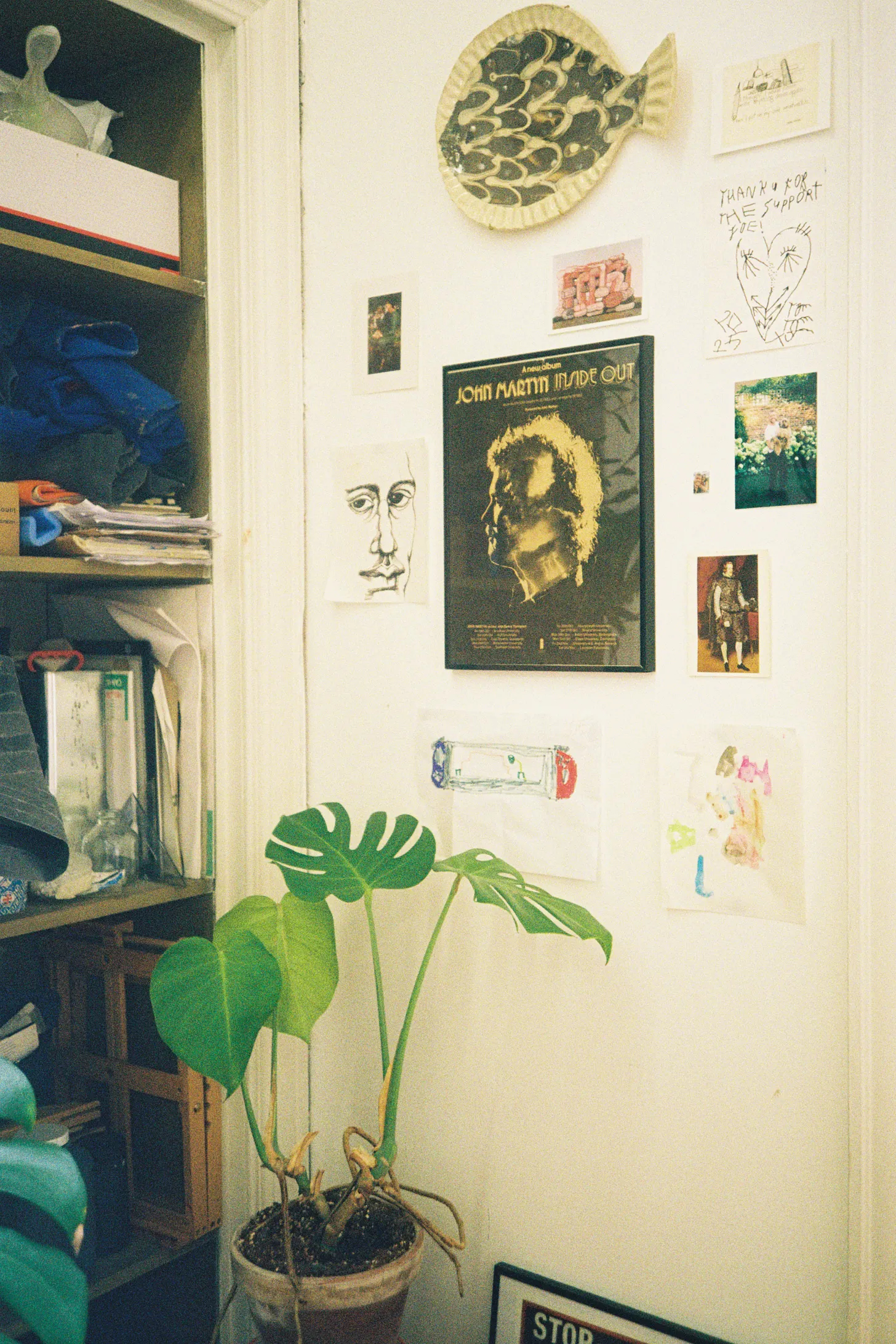
Your studio is currently in your home, how does that determine the way you work?
I used to have two studios. One was in Govan where I was working with spray paint. In fact, I had a big studio East in one of the old grammar school classrooms.
I’d changed medium for lots of different reasons; galleries, collectors, driving around, the expense of two studios, etc. With the spray paint, I had all the safety gear and extractors, but it’s so bad. I obviously couldn’t spray paint in the house. I felt like I wanted a studio where I could be on the paintings a lot. For example, on Sunday we went to Edinburgh, but I was up early before we left so I just sat down and did an hour and a half of painting. We went to Edinburgh and then I did a little bit more once we got back and you can’t do that if your studio is a twenty minute drive away or half an hour drive away. A home studio also suits the way that I work. I’m quite routine. You have to be quite routine making these paintings. Most of the days are very similar. It allows me to settle into that monotony.
This flat, it’s unusual in that it doesn’t have anyone across from it. The light is not perfect, it’s a bit low in the winter, but it’s really good. For lots of different reasons, it just makes sense. It definitely has an impact on the work.
I’m not a messy painter and you can see it’s quite clean. One of my favorite painters is Michaël Borremans, a great referential. He said he was dropping his daughter off at work one day and he had a suit on because he was still working. He was a school teacher at the time. He came home and started painting because he had the suit on and it made him paint a certain way. Maybe he was more careful or it just put him in a particular head space.
It’s like how some people wake up and immediately shower and put proper clothes on in order to be more productive throughout the day.
Yea, exactly. Having a studio at home puts you in a certain state of mind.
Long term I would like to move the studio back out of the house again. But within range. I think the dream would be somewhere where I have a large garden and my studio would be at the end of the garden or something. I don’t need too much space.
—
In the Studio is a monthly series interviewing Scotland-based artists and curators in their studios, conducted by Chaz Scott, a curator and art historian based between Baltimore, Maryland and Glasgow, Scotland.
